Updated: 13 September 2026
Self-driving cars have been talked about for years.
For most UK drivers, though, they have always felt like something that belonged in the future.
That has now started to change.
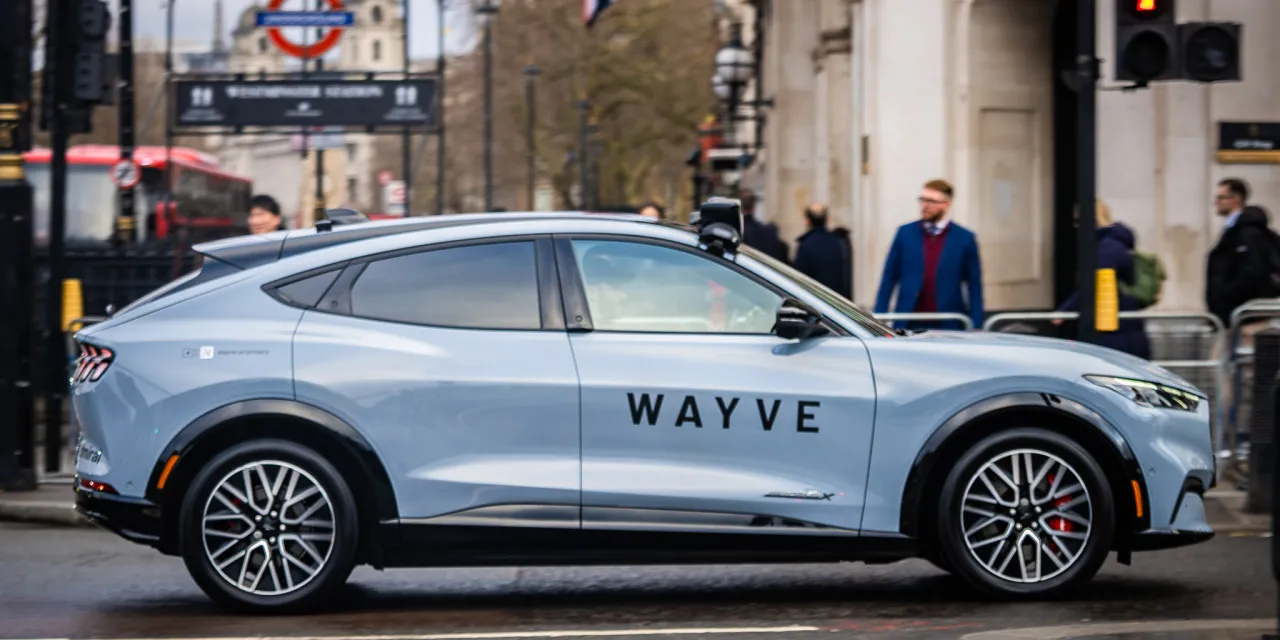
Uber and British autonomous-driving company Wayve have launched supervised self-driving rides in London, making autonomous rides available to members of the UK public for the first time.
Londoners booking an UberX, Uber Electric or Uber Comfort can now be matched with an electric Ford Mustang Mach-E fitted with Wayve’s autonomous-driving technology. More than 140,000 people had already opted in to increase their chances of getting one.
But these cars are not travelling around London completely on their own.
A trained, TfL-licensed private-hire driver remains in the driver’s seat and can take control if needed.
So Britain hasn’t quite entered the fully driverless era yet.
But we’re closer than we’ve ever been.
What Has Actually Launched in London?
Uber and Wayve launched the service at the beginning of September.
A small fleet of electric Ford Mustang Mach-Es is being used initially. The cars are equipped with Wayve’s AI Driver system and sensors that allow the vehicle to understand its surroundings and control the car.
Passengers don’t need a separate app.
If you’re requesting an eligible Uber journey in London, you could simply be matched with one.
If that happens, Uber gives you the choice to accept the autonomous vehicle or switch back to a conventional car before it arrives.
The service currently operates across London, excluding airports.
For passengers, the experience is deliberately designed to feel fairly normal.
You book through Uber.
A car arrives.
You get in.
And the difference is that much of the driving is being handled by software rather than the person sitting at the wheel.
Are These Really Driverless Cars?
Not yet.
This distinction matters because some of the headlines around robotaxis can make it sound as though cars with nobody in the driver’s seat are already collecting passengers around London.
They aren’t.
The current Uber and Wayve service is supervised autonomous driving.
A licensed driver remains behind the wheel to monitor the vehicle and intervene when necessary.
TfL approved a trial involving up to 15 vehicles for a year on that supervised basis.
Fully autonomous passenger services, where there is no safety driver, are the next much bigger step.
And the UK is already preparing for them.
When Could Cars Start Operating Without a Driver?
The Government has created a pilot scheme that allows companies to apply to run commercial self-driving services without a safety driver in England, Scotland and Wales.
The broader legal framework comes from the Automated Vehicles Act 2024.
The Government says the full framework is expected to come into force in late 2027, while the current pilot programme is intended to help regulators and operators learn how these services work in the real world.
Safety is a major part of that process.
The Government’s stated aim is for authorised autonomous vehicles to achieve a level of safety equal to or higher than that of a careful and competent human driver.
So the London service we’re seeing today is better viewed as a bridge between traditional driving and genuinely driverless transport.
How Does Wayve’s Self-Driving Technology Work?
Wayve takes a slightly different approach from some autonomous-driving companies.
Rather than relying mainly on detailed maps and large sets of hand-written driving rules, its system uses artificial intelligence trained from driving experience.
Wayve describes its approach as an AI Driver that can learn how to handle different roads and situations rather than needing every scenario to be programmed individually.
And London is quite a place to test that idea.
Anyone who has driven through the capital knows how unpredictable it can be.
Cyclists.
Pedestrians.
Buses.
Delivery vans.
Motorcycles filtering through traffic.
Temporary roadworks.
Narrow streets.
Cars stopping without warning.
If autonomous vehicles eventually manage those conditions reliably, it would be a meaningful test of the technology.
Could Self-Driving Cars Replace Normal Cars?
Probably not anytime soon.
The first widespread use of autonomous vehicles may not even involve people buying their own self-driving cars.
It may be fleets.
Ride-hailing companies could operate thousands of autonomous vehicles that spend most of their time moving passengers rather than sitting parked outside someone’s house.
That raises an interesting question.
If you could call an autonomous car within a few minutes whenever you needed one, would everyone still want to own a car?
For many people, the answer will still be yes.
A family car gives you flexibility, storage and freedom that a taxi service doesn’t necessarily provide.
But in cities such as London, autonomous ride-hailing could eventually give some people another reason to live without their own vehicle.
The change is likely to be gradual rather than an overnight replacement of private car ownership.
What Could This Mean for Taxi and Private-Hire Drivers?
This is one of the most difficult questions around autonomous vehicles.
For now, Uber says its intention is to operate a hybrid network, where autonomous vehicles and human drivers work alongside each other.
But if vehicles can eventually operate without someone behind the wheel, there are obvious questions about what that means for driving jobs.
The debate has already reached the point where a UK thinktank has proposed taxing autonomous vehicles partly to address potential job losses and wider effects on transport.
That proposal is not government policy, but it shows how quickly the discussion is moving from technology to jobs, congestion and taxation.
There is no clear answer yet.
Autonomous vehicles could remove some driving roles while creating others around fleet management, maintenance, charging, cleaning, remote assistance, software and vehicle operations.
The scale of either effect will depend on how widely the technology is eventually adopted.
Could Self-Driving Cars Change Car Dealerships?
Potentially.
Imagine a dealership receiving a used car that can drive itself.
In the longer term, an autonomous vehicle could theoretically move between dealerships, storage sites, inspection centres or customers with much less human involvement.
That doesn’t mean vehicle logistics disappears.
Far from it.
Cars would still need to be:
transported in bulk
moved when unregistered
collected after collisions
recovered when faulty
delivered when they cannot legally be driven
moved long distances efficiently
And transporting several cars on one transporter will often make considerably more sense than sending each vehicle individually along the same motorway.
But autonomous technology could change some of the shorter vehicle movements that dealerships currently rely on drivers to complete.
Autonomous Fleets Could Create a New Vehicle-Logistics Industry
Robotaxis sound like a software story, but they are also a fleet-management story.
If autonomous ride-hailing grows, operators could eventually manage hundreds or thousands of vehicles in a city.
Those cars will need:
charging
cleaning
tyres
servicing
repairs
MOT testing where applicable
bodywork
software maintenance
storage
repositioning
And sometimes they will need physically moving from one location to another.
That creates a different type of automotive logistics market.
A robotaxi that develops a fault cannot simply continue earning money until someone eventually looks at it.
Fleet operators will want vehicles returned to service quickly.
That could make efficient vehicle transport and fleet recovery even more important rather than less important.
What Happens When a Self-Driving Car Breaks Down?
Autonomous doesn’t mean indestructible.
These vehicles still have tyres, suspension, batteries, brakes, electronics and thousands of physical components.
They can still suffer punctures.
They can still be involved in collisions.
They can still develop faults.
And electric autonomous cars can still run into charging or battery-related problems.
The difference is that recovery companies may eventually be dealing with vehicles containing far more autonomous hardware and sensitive sensor equipment.
Recovery procedures may therefore become more specialised.
Providers might need information about how a vehicle should be moved, whether autonomous systems have been safely disabled and whether the manufacturer requires particular recovery methods.
If the vehicle cannot move under its own power, vehicle recovery remains necessary regardless of who — or what — was originally driving it.
Electric Cars and Autonomous Cars Are Becoming Closely Linked
It is also worth noting that the Wayve vehicles being used in London are fully electric.
That isn’t unusual.
Many of the world’s autonomous-vehicle projects are being built around EV platforms.
It makes sense.
Electric cars already contain sophisticated electronic control systems, while commercial robotaxi fleets also benefit from lower running costs and the ability to return to central charging locations.
And this comes at a time when UK electric-car ownership itself is growing quickly.
We’ve recently looked at the sharp rise in UK electric car ownership, with EVs becoming an increasingly normal part of the country’s new and used-car markets.
Autonomous driving could be another stage of the same wider shift.
The car isn’t simply changing from petrol to electric.
It is gradually becoming more connected, more software-driven and more capable of doing things without direct input from its owner.
Are Self-Driving Cars Safe?
This will probably determine whether people actually accept them.
There is a big difference between thinking autonomous cars are interesting and trusting one enough to put your family inside it.
And public opinion remains mixed.
The current London service keeps a licensed driver onboard partly because this technology is still moving through a controlled rollout.
The Government is also building safety assessment and monitoring into its autonomous passenger rules rather than simply allowing companies to deploy vehicles without oversight.
That is important because autonomous vehicles will eventually be judged against human drivers.
Not against perfection.
Humans make mistakes every day.
We get distracted.
We misjudge gaps.
We get tired.
We speed.
A useful measure of autonomous technology will therefore be whether it can eventually produce fewer serious incidents than human drivers while still dealing reliably with unusual situations.
That will take time and good-quality real-world evidence.
Would You Get Into One?
This may be the more interesting question.
More than 140,000 Londoners opted in before the service had properly got going, which suggests there is plenty of curiosity.
But curiosity and long-term trust are different things.
People may happily try a supervised autonomous Uber once.
The bigger test comes when the driver disappears.
Would you get into a car with an empty driver’s seat?
Would you allow your children to travel in one?
Would you trust it on a motorway?
Would you buy one yourself?
Those are questions the automotive industry may have to answer much sooner than many of us expected.
What Happens Next?
London is unlikely to be the end of this story.
Wayve and Uber are starting with a relatively small supervised fleet, but both companies have much larger ambitions.
Other autonomous vehicle companies have also shown interest in operating passenger services in London, including Waymo and partnerships involving Baidu, Uber and Lyft.
At the same time, UK regulators are establishing the rules that could allow commercial vehicles to operate without safety drivers.
So 2026 may eventually be remembered as an important dividing line.
Before this year, self-driving taxis in Britain were mainly something being tested.
Now ordinary passengers can actually book a ride and experience one.
There is still a person behind the wheel.
There are still regulatory hurdles.
And there are still major questions around safety, employment, congestion, insurance and public trust.
But self-driving cars are no longer simply a prediction about the future.
They’re already carrying passengers on British roads.
What Could This Mean for RecoBuddy?
For RecoBuddy, autonomous vehicles don’t make vehicle transport and recovery irrelevant.
They could eventually create new types of work.
Large autonomous fleets will still need cars moved between depots, garages, dealers and operating areas.
Damaged or faulty autonomous cars will still need recovery.
Vehicles bought and sold through dealerships and auctions will still need transporting.
And as cars become heavier, electric and more technically complex, using the correct equipment and provider could become even more important.
The technology driving the car may change.
The need to physically move vehicles around the country won’t disappear.
self-driving cars UK